16 May, 2006

St. Patrick's People


Tough times in St. Patricks. The Dublin Ambulance crew are worried about the men. They say that organ failure can happen as quickly as a heart attack.

The UNHCR says "the significant upsurge in violence in some parts of the country has limited the access to those areas by both international humanitarian actors and Government representatives, denying the population access to entitlements, services and protection." Meanwhile the Department of Foreign Affairs tells us not to visit.

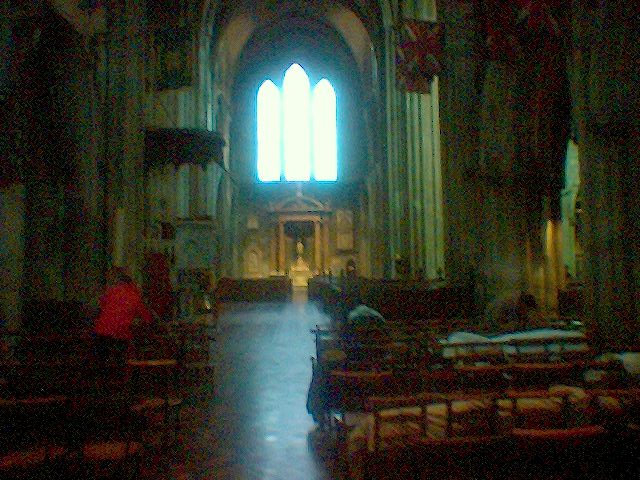
Above the men hang the regimental flags from long ago. A plaque on the nearby walls states "Sacred to the memory of James Slator Cummings Esquire, Liutenant in the 9th Regiment of Foot who was killed in action in Afghanistan at the forcing of the Kyber Pass on the 5th April 1842 aged 23 years while gallantly leading a company of that regiment, a brave soldier and a sincere christian."

As a friend of St. Patrick's Cathedral I never thought I'd see a scene like this within the walls. I'm glad to hear reports that the hunger strikers are taking water. The children should give up their strike now. It is heartening that the Department of Justice will meet with the men.
This case highlights the difficulties of the refugee appeals system in Ireland.

The Refugee Appeals Tribunal is famous for the secrecy under which it operates and the lack of transparency surrounding its decision making process. The Minister appoints the members of the Tribunal and there is no independent selection or interview procedure. Only one case in five cases of those who have sought asylum here has been granted. Of course the system can be abused, but these men are desperate and we need transparancy to ensure that these mens' applications are carefully considered.




03 May, 2006

Yellow journalism

The politics of colour showed through in John Lalor’s piece in this months Magill magazine. Headed ‘Green for Danger’ the author attempted to show that the Greens are for the birds. The piece mocks the environmental movement, and suggests that environmentalism creates the mirage of ‘community’. Although the writer states that the statements from the likes of Dave Foreman have no official connection with the Irish Green Party, the strawman is carefully positioned for maximum effect. Joschka Fischer’s behaviour is also ridiculed, but Lalor heads back almost forty years for that particular piece of mud-raking, and ends up by suggesting that under the camouflage of Green policies red hearts are beating strongly.

Not in Vanity Fair I suspect. Editor Graydon Carter suggests that ‘Green is the New Black’. In the Green Issue George Clooney, Julia Roberts, Robert F Kennedy Jr. and Al Gore contribute, and call for a new environmental revolution. I particularly liked Al Gore’s article where he quotes General Omar Bradley who said at the end of World War II: ‘It is time we steered by the stars and not by the lights of each passing ship’. It is also important to stress as Al Gore does that a more environmentally sound future can be a good news story. If we want to, it can include better planned neighbourhoods, more Brownfield rather than Greenfield sites; homes that are better insulated and cheaper to heat, more time with your kids. It does involve government support and intervention though, and a laissez-faire approach just won’t deliver the goods.

21 April, 2006

Up the Republic!


That phrase felt like the right greeting last Sunday evening at the post-parade bash in Dublin Castle. I used it a few times, but after a few raised eyebrows I kept it to myself. Someone suggested that it was more appropriate to a drunken fan during a Munster Final, so that shut me up. The parade seemed too militaristic for my liking, and more of a cynical attempt to reclaim the votes lost to Sinn Fein, rather that any serious attempt to honour those of 1916. I’m not quite sure whether the fallen heroes would have appreciated the three Government jets.

The post-parade party in Dublin Castle was another thing entirely. It was a celebration, and a good one at that. I met Michael Collins’s grand nieces, and they seemed delighted with the day. One corner of St. Patrick’s hall seemed jammed with de Valeras of various descriptions. The outside corridor was packed with army top brass at one end, facing off the diplomatic corps at the other. The State Apartments were open, but it came as a shock to enter the room where a wounded Connolly had spent his final days prior to execution.

We held an American wake on Easter Sunday for my brother who was heading off to work in Connecticut. My sister was concerned that the next generation weren’t up to speed on their history and had made up a series of sketches to introduce them to their past. Important to stress the German connection to my nieces whose mum is from those parts, but more confusing to explain how my great-uncle Ignatius was in the British army while another great-uncle Patrick was busy setting up the Irish National League, and editing An Phoblacht.

Some great stories came out of the last fortnight. I remembered a conversation a few years ago with an elderly nun who described lashing down York Street with her sister to see a woman wearing trousers in Stephen’s Green. Constance Markievicz apparently instructed them to “Go home Children, you might get hurt.” Good advice, as she was no pacifist herself.

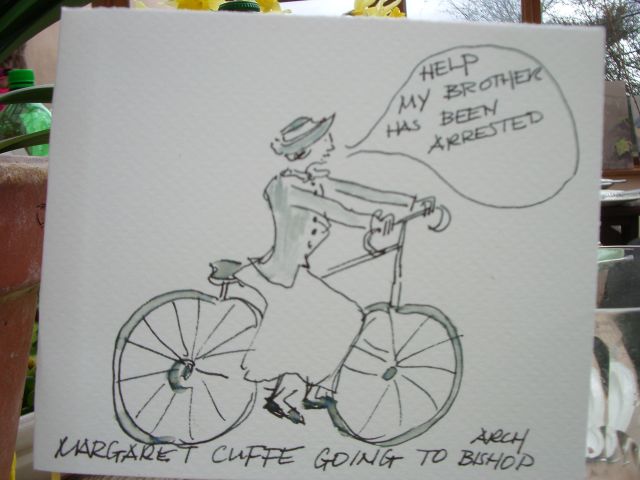
I met my aunt Mairín at the opening of the 1916 exhibit at the National Museum at Collins Barracks. She remembers sheltering under the dining-room table in their home on Mary’s Road off Baggot Street as the bullets flew from the shoot-out around the corner on Northumberland Road where many rebels, and members of the Sherwood Foresters Regiment were killed or injured. Meanwhile their mother was off on her bike trying to get the Archbishop to intervene and release her arrested brother Paddy. All in all, it was a fascinating few days, both then and now.

21 March, 2006

Dublin Bay's Future

Dublin Bay. Love it, hate it, ignore it at your peril. For many of us it's on our doorstep. We swim in it fish in it and dumped our sewage in it until recently.. The good news is its getting cleaner. The bad news is that nobody's in charge. That's why I'm organising a Conference - Dublin Bay Futures on Saturday 8th April in the Kingston Hotel, Dún Laoghaire between 10 am and 4 pm. We've a good line-up of speakers - Karin Dubsky of Coastwatch Europe, Dick Gleeson the Dublin City Planning Officer, Michael Collins of the S2S coastal cycleway proposal, even Richard Boyd Barrett from Save our Seafront. Should we build on the Poolbeg peninsula? What future for Dún Laoghaire baths? All of this, and more. You can register online, and its free. Hope to see you there.